
There is a particular kind of fatigue that no spa treatment can reach. It is not physical. It is the exhaustion of too much choice, too much noise, too much frictionless convenience, a life so optimized that it has quietly lost its texture. The guests arriving at the most sought-after retreats today are not broken. They are simply full, and in search of empty.
What the market is responding to, somewhat dramatically, is this: the most meaningful luxury experiences of the moment are defined not by what they add, but by what they deliberately remove.
We live in a world of endless choice, and it is exhausting.
Studies suggest the average adult makes over 30,000 micro-decisions every single day. Research from Deloitte shows that travelers now spend more than five hours researching and comparing options before a single booking is made, scrolling through reviews, cross-referencing itineraries, negotiating preferences across group chats that have long since ceased to be enjoyable.
Travel, once a genuine break from the demands of daily decision-making, has quietly become another arena of optimization. The group holiday (in theory a shared joy) has in practice become a project. Someone coordinates the flights. Someone researches the restaurants. Someone holds the group chat together through the competing preferences, the dietary requirements, the varying budgets, and the endless deferral of the question: but what does everyone actually want?
By the time the group arrives, they are already tired. Not from the journey, but from the planning of it.
“The most radical thing a retreat can offer, in 2026, is the removal of the burden of choice.”
This is what a considered all-inclusive wellness retreat offers. Not the traditional bracelet-and-buffet model, but something far more intentional. Movement, nourishment, restoration, and time outdoors woven seamlessly into the experience, so that the guest arrives and finds everything already thought through. The decision has been made, and it was made beautifully. All that remains is to be present for it.
For a group, this is quietly transformative. When no one is coordinating, everyone can finally connect. When the itinerary is handled, the conversation can go somewhere real. The shared meal that was curated, the morning session that was prepared, the evening that simply unfolds. These are the conditions in which groups stop being logistics and start being people again.
Shabby Chic Didn’t Disapper. It Grew Up
What the nineties called “shabby chic” – the worn linen, the reclaimed timber, the deliberate imperfection – was always pointing toward something the market hadn’t yet named. It was pointing toward authenticity. The aesthetic was borrowed. The longing beneath it was real.
That longing has now matured into a full design philosophy and a serious travel category. You see it in the ranches and estancias drawing urban professionals to the countryside, where the standard is impeccable but the experience is deliberately rustic, and guests feel they have entered someone’s home rather than a managed product. You see it in boutique hotels that have stripped back the amenity count and invested instead in the quality of silence. You see it in the rise of what travel editors are calling “elemental travel”. Retreats built around open land, ancient ceremony, and the body in motion: things that predate the hotel industry entirely.
“Rustic and refined are no longer opposites. In the most considered retreats, they are collaborators.”
The five-star experience and the unhurried morning still occupy the same space. The court, the fairway, the treatment room, and the dinner table are no longer separate itinerary items, they are acts in the same story.
What guests are actually seeking, and what sport and wellness have to do with it
Strip away the trend language and three genuine human needs emerge, the same ones that have always animated the best hospitality, now arriving with a new urgency.
Connection to body. The wellness market has moved decisively from indulgence toward investment. Guests who once booked a massage now seek experiences designed to meaningfully extend their physical capacity. Increasingly, sport is the vehicle. Tennis, padel, and golf have emerged as the social architectures of the high-performance retreat: they require presence, they create natural competition and camaraderie, and they make the body the subject of the day in a way that a spa morning quietly avoids. Alongside this, a new category is taking shape: medical wellness, where biometric analysis, precision diagnostics, and longevity protocols give guests not just restoration but a genuine map of themselves. More than 90 percent of luxury travelers now actively seek wellness programming when booking a trip. The body has become a site of serious, curious investment.
Connection to place. The repeat luxury traveler, the one who has already done Maldives, already done Tuscany, is no longer looking for another beautiful property. They are looking for a place that is irreducibly itself. Somewhere that could not exist anywhere else. A city with genuine history still alive in its streets. A landscape that imposes its own rhythm. An experience so embedded in its location that transporting it elsewhere would destroy it entirely.
Connection to one another. Perhaps the most underrated force in luxury travel right now. The best retreats create conditions where genuine encounter becomes possible – between strangers who quickly cease to be strangers, between professionals who rediscover something beyond their professional identity. A padel match at dusk, a round of golf at sunrise, a shared treatment protocol. Sport and wellness are uniquely good at dissolving the professional armour that most guests arrive wearing. Belonging, as a hospitality metric, is quietly becoming the hardest one to manufacture and the one guests remember longest.
Together – and alone. Both are retreat.
Most retreats are built around the group. And rightly so. There is something irreplaceable about shared experience, about the particular quality of trust that forms between people who have moved, rested, and been honest together in an unfamiliar place. The group retreat has become one of the defining rituals of high-achieving professional life: a moment to step away collectively, recalibrate, and return changed.
But the group is not the only way to retreat. And for a certain kind of traveler, the one who gives everything to everyone, whose life is structured entirely around others, the most radical act is to arrive alone.
The solo retreat is not loneliness dressed up as luxury. It is one of the most intentional things a person can choose to do. To step away from the noise of one’s own life, to arrive in a place of genuine beauty with no obligations and no audience, and to simply be – in the Caribbean light, beside the sea, with the body moving freely and the mind finally permitted to slow -is a kind of restoration that the group experience, for all its richness, cannot replicate.
Stop Planning. Start Arriving.
What Sanfelino builds, and why Cartagena is the right place to build it
Cartagena does not require a constructed narrative. The Walled City carries five centuries of layered identity – colonial architecture, Caribbean rhythm, a culture that is genuinely its own rather than curated for external consumption. The Rosario Islands offer that particular quality of Caribbean stillness that cannot be engineered. The coast, the food, the pace of local life – none of it is borrowed from somewhere else. It simply is.
This is the backdrop against which Sanfelino’s retreats are designed. Not as a hotel programme, not as a tour package, but as a curator of encounters. With this city. With one another. With whatever dimension of themselves the guest most needs to recover.
Sport and Performance
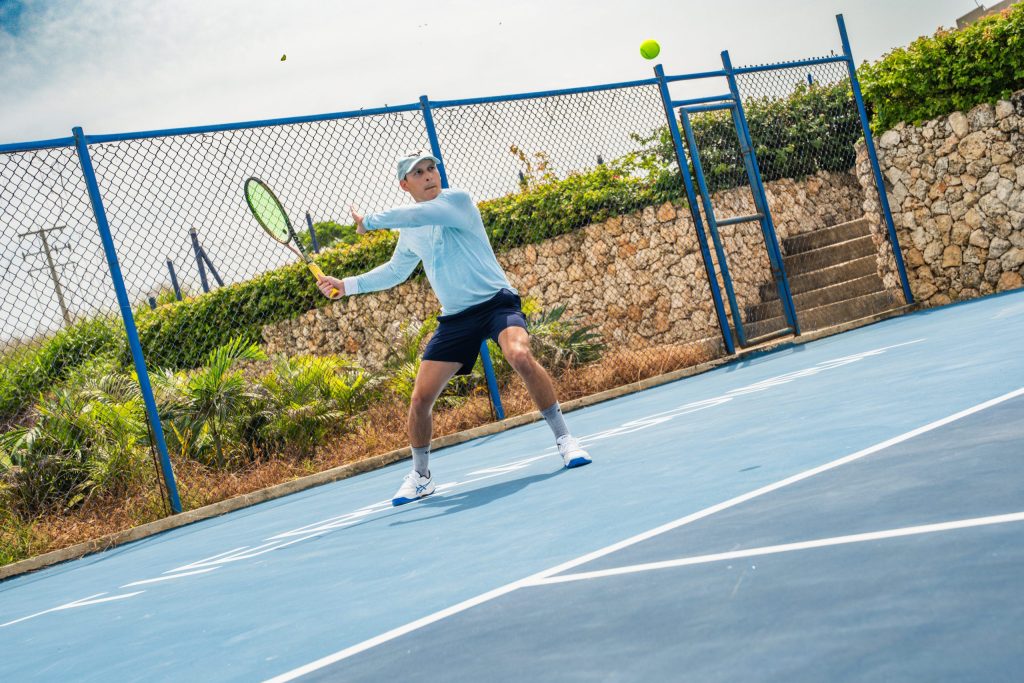
Tennis & Padel Retreat
On-court mornings, recovery afternoons, and the particular intimacy that forms between people who compete together. Movement as the social container; Cartagena as the backdrop.
Fairways and Stillness
Golf & Wellness Retreat
Early rounds on world-class Colombian courses, afternoon restoration, and evenings that belong entirely to the group. The pace of golf as a philosophy, not just a sport.
Restoration and Longevity
Medical Wellness Retreat
Precision diagnostics, biometric insight, and expert-led protocols designed to leave guests with more than rest; a deeper, clearer understanding of their own body and its next chapter.
Corporate and Incentive
Executive Retreat
Designed for groups who arrive as colleagues and leave as something more. Strategy and restoration woven together. The Caribbean as a reset for high-performance teams.