
I took the moto out early and rode the length of Avenida Santander with the sea on one side and the old city on the other, headed for the Hyatt in Bocagrande – not because anyone needed me there, but because I wanted to watch the minivan arrive on time with my own eyes.
Fourteen guests, two consultants, and one small logistical truth: there is nowhere for a minivan to wait outside the Hyatt. So while the team ran the morning briefing, the driver circled the block and our logistics line stayed open the entire time – a quiet piece of choreography between dispatch and driver, timed so the van pulled up exactly as sixteen people stepped out the door. Nobody waited. Nobody noticed. That is rather the point.
Then back on the moto, in convoy to the marina.
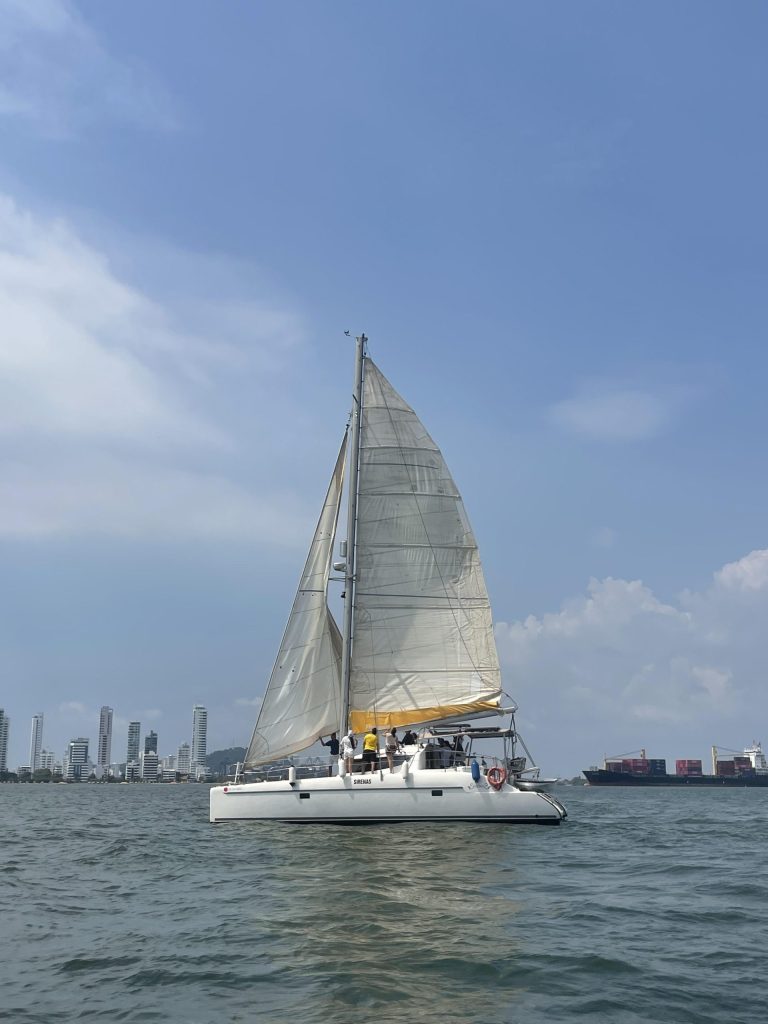
We met the captains, split the group into crews, and let each one claim their catamaran. Sirena and Armonia. Everyone boarded while we went ahead to mark the racing lines. Three, two, one, go.
Sirena surged ahead. In fairness, the judge had granted Armonia a six-minute courtesy for the difference in size between the two boats, a head start, in spirit. It didn’t matter: the crews found their rhythm, sailed as one, and Sirena crossed the line first… by crashing into it. Quite literally.
In a real regatta, that’s a forfeit. Which made it the most useful thing that happened all day – a clean, undeniable lesson in owning your mistake and learning from it. So it was Armonia who popped the champagne. The boat that came second, and the crew that kept it together, took the day.
You couldn’t have scripted it. Which, as it happens, is the whole point.
What makes Cartagena a strong destination for corporate events?
Before we get to boats and briefs, it’s worth saying plainly why any of this happens here in the first place.
Cartagena de Indias is, quietly, one of the most capable event cities in the Americas, and most companies discover this by accident. It sits a short flight from Miami and well within reach of the rest of the hemisphere, so a team can leave home in the morning and be on the water by the afternoon. The climate is dependable in a way northern cities can only envy: warm, bright, and built for the outdoors nearly year-round.
Then there is the city itself. The Walled City is a UNESCO World Heritage site you can cross on foot. Sixteenth-century plazas, courtyards, and rooftops that no purpose-built convention centre could imitate if it tried. Just beyond it sits the bay, the Rosario Islands, and the beaches of Barú: an entire archipelago of venues most planners don’t realise they have.
And underneath the romance, the unglamorous essentials are all in place, international-standard hotels, a mature events and hospitality infrastructure, and a concierge ecosystem that knows how to run all of it discreetly. Sanfelino is a luxury concierge and destination management company (DMC) based here, which is to say we don’t import the city from a brochure. We’re from it.
Why hold a corporate event outdoors instead of in a conference room?
The brief arrived the way these things usually do: abstract. A consulting group was running a leadership programme for a team of medics, and they wanted a day built around a single idea – managing unpredictability, staying composed when the situation refuses to follow the plan.
Most vendors hear that and reach for a hotel. A breakout room, a slide deck on “adaptive leadership,” a laminated agenda, a coffee station at the back.
We heard the bay.
Because here is the quiet problem with the conference room: nobody remembers it. You can teach composure under pressure in a windowless room with very good catering, and people will nod, and they will forget. The lesson never leaves the building because the pressure was never real. There was nothing at stake but the schedule.
Our argument is a simple one: if you want a team to change how it thinks, the venue is not a detail. The venue is the message. And Cartagena gives you a bay where most cities give you a ballroom.
What can a sailing regatta teach a team about leadership under pressure?
Quite a lot, it turns out, because the sea does not care who you are.
We put the group into crews and onto the water for a friendly regatta – friendly in the sense that no one was a professional sailor, not in the sense that nothing was at stake. There was a course, there were competitors, and there was wind, the one variable no facilitator can put on a slide. What the crews carried home wasn’t one tidy takeaway. It was several, and the sharpest of them were never on the agenda.
The first was that roles beat rank. A catamaran doesn’t care about your title; it needs someone on the helm, someone on the sail, someone calling the next move, and those jobs fall to whoever can do them rather than to whoever outranks the room on dry land. For professionals who spend their working lives inside a strict hierarchy, feeling the order of a crew turn functional rather than titular is a quietly radical thing.
The second was that a team only moves as one. A boat punishes disagreement instantly and visibly, pull in different directions and you simply stop, no memo required, just the plain physics of going nowhere. The crews that found a rhythm found their speed. The lesson arrived not as advice but as consequence.
The third was that you sail the boat you’re given. Sirena and Armonia weren’t the same size, so the judge handed the smaller boat a six-minute courtesy to even the contest, a neat reminder that fairness isn’t treating everyone identically; it’s accounting for the conditions each crew actually starts with. Nobody chose their boat or their wind. They had to do the most with what was in front of them, which is most of leadership in a single sentence.
The fourth was the one nobody saw coming. Sirena crashed into first place (literally). In a real regatta that’s a forfeit, and some aboard knew it, others celebrated premature victory. So the champagne went to Armonia: the boat that came second and kept itself together. For a room full of people whose profession begins with do no harm, the point landed without anyone having to make it. Speed is worth nothing if you arrive broken, and owning the mistake is the first half of learning from it.
That last lesson is the one the consulting group actually asked for, and the sea delivered it without a single slide. Composure under pressure isn’t something you explain to people; it’s something they do – badly at first, while the clock runs and the wind does as it pleases. For a group whose entire careers are built on staying calm in a crisis, the novelty was never the pressure. It was pressure they couldn’t out-credential.
They came off the water having felt the things the brief had only named.
So… what kinds of corporate events can you host in Cartagena?
Here is the part worth underlining, because it’s the whole point: a regatta was the right answer to that brief. It would have been the wrong answer to a different one.
The skill on display was never “we run regattas.” It was reading an objective and building the experience that delivers it. The boats were a translation, not a product. And once you think that way, Cartagena stops being a backdrop and becomes a kit of possibilities. You match the experience to the goal:
- A leadership team that needs to rebuild trust → an off-road ATV expedition through the trails beyond the city, where paired riders trade the wheel across the course and have to trust each other’s calls at speed.
- A product launch that needs to feel like an event → dinner after dark in a sixteenth-century courtyard inside the Walled City, the kind of room that does half the work before anyone speaks.
- A sales team that needs energy and a reward worth chasing → a fast, competitive scavenger hunt through the colourful streets of the Walled City, teams racing clue to clue with a prize, and a year’s worth of bragging rights, waiting at the finish.
None of these is a regatta. All of them come from the same move: understand what the event needs to accomplish, then build backwards from there.
Why use a local concierge agency for a corporate event in Cartagena?
Because the creativity is only half of it. The other half is knowing the city well enough to make the creativity safe.
Anyone can rent a ballroom. What a conference room offers, and it is the only thing it offers, is predictability. The genuinely creative event has to earn that predictability the hard way: which captain, which courtyard, which island, which contingency for the afternoon the weather turns. The spontaneity your guests feel on the day is built on logistics they will never see and were never meant to.
That is the part that takes a real Cartagenero rather than a catalogue. The regatta felt like controlled chaos to the people in the boats. To us, it was weather contingencies, safety margins, and quiet coordination, arranged so that the only thing the physicians had to manage was the wind.
Creative is not the opposite of safe. Done properly, creative is harder than safe, because someone has to engineer the freedom.
Frequently asked questions
How many people can attend a corporate regatta in Cartagena? The format scales comfortably from small leadership teams to groups of several dozen across multiple boats. The right number depends on your objective and the experience you want on the water, which is something we plan around your group rather than ours.
Do participants need sailing experience? No. Our regatta-style events are designed for complete beginners, with crews and guidance arranged so the focus stays on the team dynamic rather than technical skill. The point is what happens under pressure, not how well anyone trims a sail.
What’s the best time of year for a corporate event in Cartagena? Cartagena is a year-round destination, with the driest and most reliable conditions generally falling between December and April. We plan every event with seasonal weather built into the contingencies, so the experience holds regardless of when you come.
Can the event be tailored to a specific learning objective or theme? Yes. That is the core of how we work. We start from what the event needs to accomplish, whether that’s leadership, trust, celebration, or a product launch, and design the experience to deliver it. The regatta was one answer to one brief; yours may look entirely different.
Is a sailing-based corporate event safe? Safety is the foundation the whole experience is built on. Every event runs with professional crews, appropriate equipment, and weather contingencies planned in advance, so that participants can engage fully while the logistics stay firmly in our hands.